Year-end tax planning matters more than usual in 2026. It’s the first full year of several changes from the 2025 federal tax law, including a new charitable deduction for people who don’t itemize, and Michigan started its own tax breaks on tips and overtime this year. Most of these moves have to happen by December 31.
As a CPA in Huntington Woods, I put this checklist together for individuals and families across Metro Detroit. In addition, each item links to the IRS or Michigan Treasury so you can check the details yourself.

2026 tax numbers at a glance
| 2026 item | Single | Married filing jointly |
|---|---|---|
| Standard deduction | $16,100 | $32,200 |
| 401(k) employee limit | $24,500 | $24,500 each |
| IRA limit (under 50) | $7,500 | $7,500 each |
| HSA limit | $4,400 (self-only coverage) | $8,750 (family coverage) |
| Charitable deduction without itemizing | $1,000 | $2,000 |
| SALT deduction cap | $40,400 | $40,400 |
| Annual gift exclusion (per recipient) | $19,000 | $19,000 each |
Sources: IRS Rev. Proc. 2025-32, IRS retirement limits, Rev. Proc. 2025-19, IRS and the IRS SALT correction.
Year-end tax planning for retirement accounts
1. Max out your 401(k). The 2026 employee limit is $24,500, plus an $8,000 catch-up at age 50 or older, or $11,250 if you are 60 to 63 (IRS). Because 401(k) contributions come out of your paycheck, change your deferral before your last paychecks of the year. Also, if your 2025 Social Security wages from that employer topped $150,000, your 2026 catch-up contributions generally must be Roth (IRS Notice 2025-67).
2. Fund an IRA or Roth IRA. The IRA limit is $7,500, plus $1,100 if you are 50 or older. You have until the April 2027 filing deadline. However, Roth IRA eligibility phases out between $153,000 and $168,000 of income for single filers and $242,000 to $252,000 for joint filers (IRS).
3. Take your required minimum distribution. If you are 73 or older, your RMD generally must come out by December 31 (IRS Publication 590-B). Also, if you are charitable, a qualified charitable distribution (QCD) straight from your IRA to a charity counts toward your RMD, up to $111,000 for 2026 (IRS).
Year-end tax planning for charitable giving
4. Use the new deduction if you don’t itemize. Starting with 2026, you can deduct up to $1,000 of cash gifts to qualified charities ($2,000 if married filing jointly) on top of the standard deduction (IRS). Just keep a receipt or bank record for every gift.
5. Watch the new floor if you itemize. For 2026, only charitable gifts above 0.5% of your adjusted gross income are deductible (IRS Form 1040-ES). For example, with $200,000 of income the first $1,000 of gifts gives no deduction. As a result, it can make sense to “bunch” two years of giving into one year.
Claim the new deductions from the 2025 tax law
These four deductions run from 2025 through 2028, and you can take them whether or not you itemize (IRS):
- 6. Tips: up to $25,000 of qualified tips. The deduction phases out above $150,000 of modified AGI ($300,000 joint).
- 7. Overtime: up to $12,500 ($25,000 joint) of the extra pay above your regular rate, the “half” in time-and-a-half. It phases out at the same income levels.
- 8. Seniors 65 and older: an extra $6,000 per person, phasing out above $75,000 of modified AGI ($150,000 joint).
- 9. Car loan interest: up to $10,000 of interest on a loan taken out after 2024 for a personal vehicle with final assembly in the United States. It phases out above $100,000 ($200,000 joint), and you will need the VIN on your return.
So before year end, check your final pay stubs for tips and overtime, and save your car loan statements.
Year-end tax planning for investments
10. Harvest losses, and maybe gains. Selling investments at a loss can offset gains you already took this year. However, if you buy the same or a substantially identical investment within 30 days before or after the sale, the wash sale rule disallows the loss (IRS Publication 550). On the other hand, if your taxable income is under $49,450 (single) or $98,900 (joint), long-term gains may be taxed at 0% (IRS).
Health, family and gifts
11. Max out your HSA. For 2026 the limits are $4,400 for self-only coverage and $8,750 for family coverage (IRS). In addition, starting this year, bronze and catastrophic plans count as HSA-compatible (IRS).
12. Fund a Trump account for your kids. Contributions began July 4, 2026, up to $5,000 a year (IRS). Also, children who are U.S. citizens born from 2025 through 2028 can also get a $1,000 government pilot contribution. You elect it on Form 4547 (IRS).
13. Make annual exclusion gifts. You can give up to $19,000 per person in 2026 without filing a gift tax return.
Avoid an underpayment penalty
14. Check your withholding and estimates. The last 2026 estimated payment is due January 15, 2027. You can generally avoid a penalty by paying at least 100% of your 2025 tax, or 110% if your 2025 AGI was over $150,000 (IRS). The IRS Tax Withholding Estimator now reflects the new law, so it is a quick check.
Michigan year-end tax planning
- Tips and overtime: starting with 2026, Michigan lets you deduct the same qualified tips and overtime you deduct federally, through 2028 (Michigan Treasury).
- Retirement income: the phase-in is complete for 2026, so eligible pension and retirement income can be fully deductible regardless of birth year (Michigan Treasury).
- Social Security: for 2026 through 2028, eligible taxpayers born after 1952 and age 67 or older can claim both the standard deduction and the Social Security deduction (Michigan Treasury).
- 529 savings: contributions to the Michigan Education Savings Program are deductible up to $5,000 single or $10,000 joint (Michigan Treasury).
Own a business too? Read about the Michigan flow-through entity tax and the new SALT deduction limit.
Year-end tax planning FAQ
When is the deadline for most year-end tax moves?
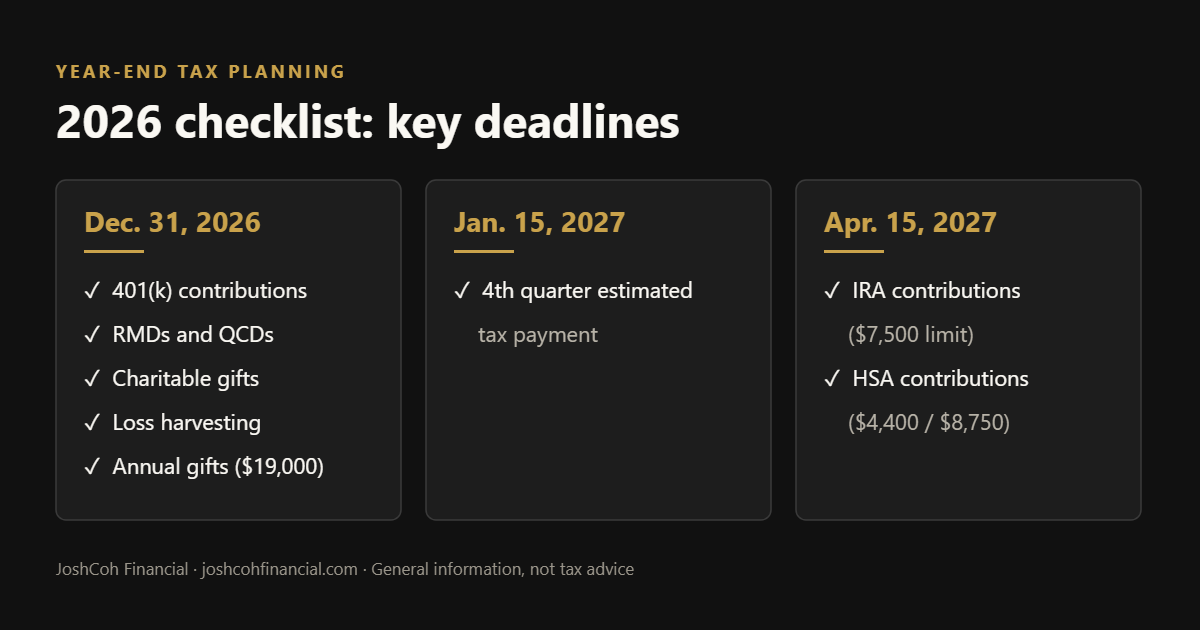
December 31, 2026 for 401(k) deferrals, RMDs, charitable gifts and loss harvesting. IRA and HSA contributions can generally wait until the April 2027 filing deadline.
Do I need to itemize to deduct donations in 2026?
No. Starting in 2026, non-itemizers can deduct up to $1,000 of cash gifts ($2,000 joint).
Are tips and overtime tax-free in Michigan?
For 2026 through 2028, Michigan allows a deduction that generally mirrors the federal one.
Get help with your year-end tax planning
Every situation is different, and some of these moves interact. So if you live in Huntington Woods, Royal Oak, Berkley or anywhere in Michigan, I can review your year before December 31. Learn more about my individual tax preparation or book a free consultation.
Related reading: Bookkeeping and tax services: why one CPA should do both · Should your small business elect S corp status?
Sources
- IRS Rev. Proc. 2025-32 (2026 inflation adjustments)
- IRS: 2026 401(k) and IRA limits
- IRS Notice 2025-67
- IRS: Working Families Tax Cuts provisions for individuals
- IRS Topic 506, Charitable contributions
- IRS 2026 Form 1040-ES
- IRS Rev. Proc. 2025-19 (HSA limits)
- IRS: Trump Accounts
- Michigan Treasury: tips and overtime deductions
- Michigan Treasury: retirement and pension benefits
This article is general information, not tax advice for your situation.
Leave a Reply