Itemized deductions can lower your tax bill, but only if they add up to more than the standard deduction. For 2026, several changes make itemizing worth a fresh look, including a much higher cap on state and local taxes. The catch is that you need good records to prove each deduction.
As a CPA in Huntington Woods, I help Metro Detroit families decide whether to itemize every tax season. Here is how itemized deductions work in 2026, which ones to track starting now, and how to keep records the IRS will accept. Every number links to the IRS so you can check it.

What are itemized deductions?
When you file your federal return, you choose one of two kinds of tax deductions: take the standard deduction, a flat amount based on your filing status, or itemize. Itemizing means listing specific expenses on Schedule A, such as mortgage interest, state and local taxes, medical bills and charitable gifts. You pick whichever option is larger, because a bigger deduction means less taxable income.
Standard deduction vs. itemized deductions in 2026
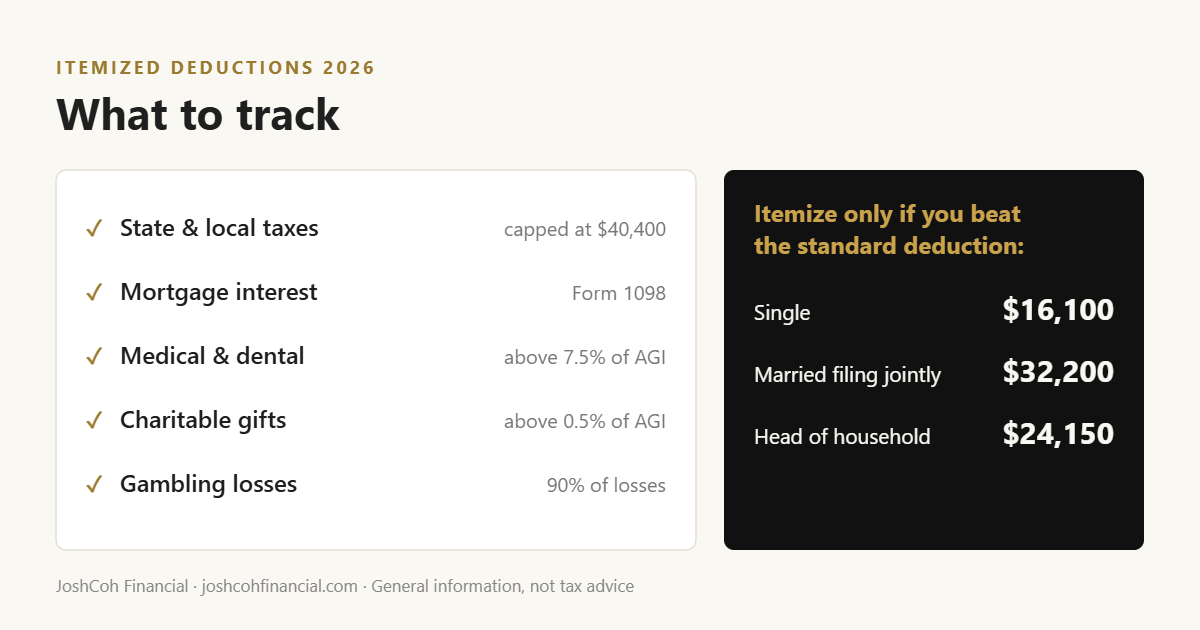
To come out ahead, your total itemized deductions need to beat these 2026 standard deduction amounts (IRS Rev. Proc. 2025-32):
| Filing status | 2026 standard deduction |
|---|---|
| Single or married filing separately | $16,100 |
| Married filing jointly | $32,200 |
| Head of household | $24,150 |
For example, a married couple whose mortgage interest, property taxes, Michigan income tax and donations total $38,000 would deduct $5,800 more by itemizing than by taking the $32,200 standard deduction.
Benefits of itemizing in 2026
- A higher SALT cap. The limit on state and local taxes rose to $40,400 for 2026 ($20,200 married filing separately). It phases down once modified AGI passes $505,000, but never below $10,000 (IRS). Read more about the new SALT deduction limit.
- A bigger deduction than the flat amount. If your expenses beat the standard deduction, every extra dollar you itemize reduces your taxable income.
- More control over timing. Because many itemized deductions depend on when you pay, you can sometimes plan which year they land in.
Itemized deductions list: what to track
Here is a list of itemized deductions most households can claim on Schedule A. Start tracking them in January, not April, because it is much easier to save a receipt today than to rebuild a year of records later.
1. SALT deduction (state and local taxes)
Track Michigan income tax withheld from your paychecks, any state estimated tax payments, and your property tax bills. In Oakland County, most homeowners pay summer and winter tax bills, so keep both, since your property tax deduction counts toward the same cap. Your total state and local taxes deduction is capped at $40,400 for 2026.
2. Mortgage interest deduction
Your lender reports mortgage interest on Form 1098. Interest is deductible on up to $750,000 of mortgage debt taken out after December 15, 2017 ($1 million for older loans). Interest on a home equity loan only counts if you used the money to buy, build or substantially improve the home (IRS Publication 936).
3. Medical expense deduction
Only the part of your medical costs above 7.5% of your adjusted gross income is deductible (IRS Topic 502). Qualifying costs include doctor and dentist bills, prescriptions, glasses and contacts, hearing aids, health insurance premiums you pay with after-tax money, and mileage to medical appointments. For example, with $80,000 of income, only medical costs above $6,000 count.
4. Charitable deduction
For 2026, itemizers can only deduct charitable gifts that exceed 0.5% of AGI (IRS Publication 505). Keep a bank record or receipt for every cash gift, and get a written acknowledgment from the charity for any gift of $250 or more (IRS). If you donate clothing or household items, write down what you gave and what it was worth.
5. Gambling losses
If you have gambling winnings, keep a log of your losses. Starting in 2026, the deduction is limited to 90% of your losses, and it can never exceed your winnings (IRS Publication 505).
How to track itemized deductions during the year
- Make one folder. Use a single digital folder for 1098s, property tax bills, medical receipts and donation letters.
- Save receipts the day you pay. Snap a photo of each medical bill or donation receipt right away.
- Check your total in the fall. By October you can usually tell whether itemizing will beat the standard deduction, which leaves time to plan.
- Keep records at least three years. That is the general period the IRS can review a return (IRS).
Smart ways to get more from itemizing
If your itemized deductions land just under the standard deduction, consider “bunching.” For example, you could give two years of donations in one year so you itemize that year, then take the standard deduction the next. Similarly, if you are planning elective medical work, putting it in the same year as other large medical bills can help you clear the 7.5% floor.
High earners should also know that for 2026, total itemized deductions may be trimmed slightly once taxable income passes $768,700 for joint filers or $640,600 for single filers (IRS Publication 505).
Do itemized deductions affect your Michigan return?
Not directly. Michigan’s MI-1040 starts with your federal adjusted gross income and uses a personal exemption instead of itemized deductions (Michigan Treasury). So itemizing changes your federal tax, while your Michigan tax is mostly based on AGI.
Itemized deductions FAQ
Should I itemize or take the standard deduction in 2026?
Itemize only if your total itemized deductions are larger than your standard deduction: $16,100 single, $32,200 married filing jointly or $24,150 head of household.
What can I itemize on my taxes?
The most common itemized deductions are state and local taxes (including property taxes), mortgage interest, medical expenses above 7.5% of AGI, charitable donations above 0.5% of AGI, and gambling losses up to your winnings.
Can I deduct property taxes if I take the standard deduction?
No. Property taxes, like the other SALT deductions, only count if you itemize.
What records do I need for itemized deductions?
Form 1098 for mortgage interest, property tax bills, pay stubs or W-2s showing state tax withheld, medical receipts, and receipts or acknowledgment letters for donations.
Do I need a CPA to itemize?
No, but a CPA or experienced tax preparer can compare both options, catch deductions you might miss and make sure your records hold up if the IRS asks. That matters most if you own a home, have large medical bills or give a lot to charity.
Get help from a local CPA
Looking for a CPA near you? I am a CPA and tax preparer based in Huntington Woods, offering individual tax return preparation for clients in Royal Oak, Berkley, Ferndale, Birmingham, Bloomfield Hills, Troy, Southfield and across Oakland County.
Whether you need a tax advisor to compare itemizing with the standard deduction, a tax accountant for a rental property or self-employed return, or simply a tax professional who will make sure no deduction gets missed, I can help. You can also work with me remotely from anywhere in Michigan.
Learn about my individual tax preparation, see the 2026 year-end tax planning checklist, or book a free consultation.
Sources
- IRS Rev. Proc. 2025-32 (2026 standard deduction)
- IRS: 2026 SALT deduction limit
- IRS Publication 936 (2026 draft), Home Mortgage Interest Deduction
- IRS Topic 502, Medical and dental expenses
- IRS Publication 505 (2026)
- IRS: Tips for tracking charitable donations
- IRS: How long should I keep records?
- Michigan Treasury: MI-1040 instructions
This article is general information, not tax advice for your situation.
Leave a Reply